India has 65 crore people under the age of 25 and 84.5 crore under 35. This makes India the youngest country and also provides an opportunity for the country to grow. But a report by the World Economic Forum says that only 2% of 1.2 crore young people who enter the job market every year have the skills they need. The Government is trying to help the youth through schemes. For example - The Pradhan Mantri Kaushal Vikas Yojana 3.0 which was launched in 2021 aims to reach 1.5 crore people.
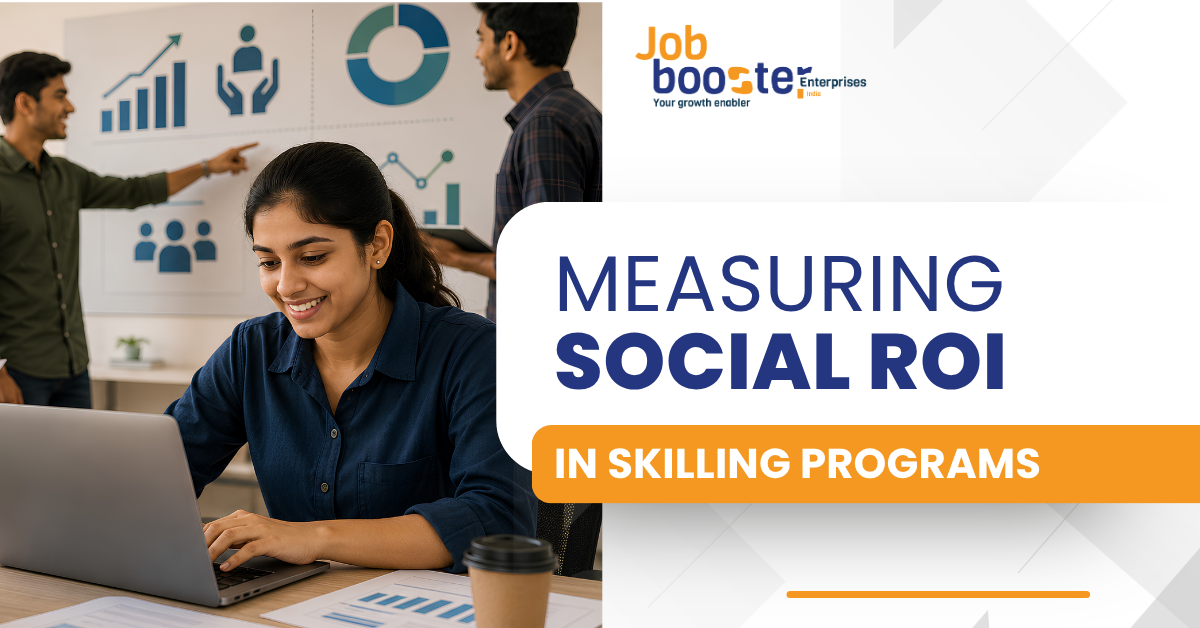
Just starting schemes is not enough. We need to check the Social Return on Investment to see the impact. This method looks at the environmental and economic value created by investments. It shows the impact by looking at things like higher household income and more stable jobs. Unlike ROI, which only looks at financial returns SROI also considers the views of stakeholders and focuses on long-term results. This is useful in understanding the impact made by the organization.
Principles of SROI
• Stakeholder engagement: You need to talk to people who are affected by the program like the people who benefit from it employees, partners and funders to understand their experiences and outcomes.
• Understand change: You need to identify the changes that happened because of the program. For example, did people get jobs, higher income or improved confidence?
• Value what matters: You need to put a value on outcomes that may not usually have a price, such as improved wellbeing or job stability.
• Focus on what’s material: You need to include the most important and relevant outcomes that truly influence decisions.
• Do not over-claim: You need to be realistic. Change may have happened due to factors not just because of the program.
• Be transparent: You need to explain how calculations were made and what assumptions were used.
• Result Verification: You need to review the data. If needed have it reviewed by a party to ensure accuracy.
SROI Types
A) Forecast: It helps companies determine the potential social value of a project.
B) Evaluative: It is conducted at the end of a project or during a long-term project when there is data to analyze.
Scope of SROI
Social Return on Investment can be used to measure the long-term impact of interventions in poverty reduction, access to schools and employment opportunities. It helps organizations make decisions on the allocation of resources. It also improves stakeholder engagement when the outcomes of the initiatives are shared with them. The data presented via Social Return on Investment analysis can be used to reduce the gaps between the initiatives and the community needs. It is also needed for policy formation.
SROI Assessment
1. Decide the Boundaries and Focus of the Analysis: You need to determine the investments or projects that will be evaluated. Determine the stakeholders who will be part of the process.
2. Results: Note down the results from the project or investment which can be negative or positive. For example, improved graduation rates, improved birth rate.
3. Estimate Value of Outcomes: After identifying the outcomes of a program or project collect data or feedback to confirm that those outcomes actually happened and can be measured. This is followed by assigning it a value.
4. Identify Impact: Check whether your interventions met your impact goals. Eliminate elements that are not caused by the program so that only the real impact is measured.
5. Calculation:
SROI = (Social Impact Value-Initial Investment Amount) / Initial Investment Amount x 100%. After calculating the outcomes of a project compare the value of those outcomes with the investment made in the program. Then verify the results to ensure the analysis is correct.
6. Using the Findings: Include the stakeholders in the report and let them see the results.
How Social Return on Investment Has Benefited Companies in India
1. HDFC Bank: HDFC Bank conducted a Social Return on Investment analysis for its CSR Project in Orissa. They found out that for every ₹1 invested ₹5.69 of value was created in communities. This indicates skills and employment opportunities. It also improved the transparency of the company with the stakeholders.
2. Dalmia Cement: Dalmia Bharat Foundation used Social Return on Investment to assess its soil and water conservation initiatives. They quantified livelihood and environmental benefits. For example, soil quality and farming outcomes. The results showed that the impact was beyond returns. This provided evidence of impact to stakeholders.
3. Hindustan Unilever: SROI was applied to their CSR projects, which focused on livelihoods and community development. The outcome was that it was able to capture both intangible benefits by translating them into monetary values. It helped the company compare the outcomes of CSR projects. The investors also saw the impact that was being made.
Conclusion
Many people believe that Social Return on Investment may not always be accurate because organizations make assumptions when putting a value on things that cannot be easily measured such as confidence or wellbeing. This can create concerns if the organization exaggerates its impact or if the results do not fairly represent the community. These problems can be reduced by using a method to measure Social Return on Investment from the beginning. When organizations carefully collect impact data and use a framework to analyze it the results become more reliable