India, which in one form or another has always been at the top of the debate of the fastest growing economies in the world, has now arrived at a point where it is seeking to develop a sense of balance that needs to come in heavy development and environmental sustainability. The effects of climate change are now to an extent that the world and countries within it have little choice but to follow the guidance of international establishments and their own governments to push for cleaner energy, more efficient consumption of resources, and to build sustainability efforts into every sector. It is thereby posed as not only a niche but a viable economic, environmental, and social future for India, in which green jobs and sustainability-based careers can develop. Emerging professions will require new skills and well-thought-out business models and accompanying policy development to develop a workforce able to respond to the challenge. The blog will explore what green jobs are, the increasing demand for them within the Indian governance and Market, the pros and cons of 'green jobs', as well as individual and institutional drives to be at the forefront of the emerging sector.
What Are Green Jobs?
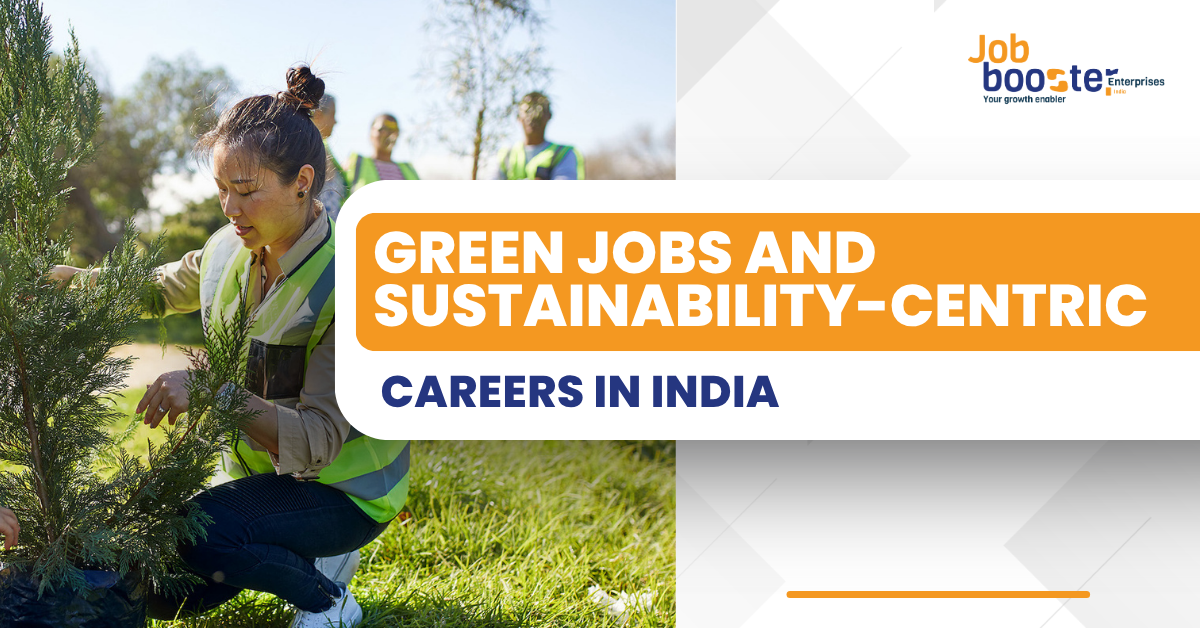
Green jobs are roles that help in maintaining or improving the environment's quality. It encompasses solar energy, wind energy, bioenergy, energy conservation, and so on, apart from pollution control, waste management, adaptation to and mitigation of climate change, and even circular economic sectors. A career option in sustainability could also be comprised of policy-making, research, consultation - ESG, climate risk, teaching, financing green projects, and undertaking responsibilities for environmental and social governance in corporations.
Why Green Jobs Are Growing in India:
Several converging forces are driving the green job boom in India:
-
Policy and National Goals:
The renewable energy domain in India has ambitious goals that cover not only the reduction of carbon emissions but also the transition to net zero by 2070. The national green hydrogen mission, solar rooftop projects, clean energy subsidies, and green infrastructure in both public and private sectors are all contributing to the creation of investment in the renewable energy sector. These kinds of policies, in turn, require skilled labor, as it is their job to implement the clean technologies and sustainable systems.
-
Corporate ESG and Investor Expectations:
The producers, investors, and regulators are all demanding more and more from companies in terms of reporting on ESG metrics. The current market situation is one where there is a very rapid enlargement of the ESG team departments, such as incorporating the activities of analysts, managers of sustainability, and even consultants in environmental issues.
-
Technological Advances & Innovation:
The renewable energy industry, among others, is transforming by means of technologies that include solar, wind, hydrogen, storage, smart grids, IoT, democratization of climate data, GIS, and digital tools for tracking the carbon footprint. These technologies demand both technical and cross-functional skills.
-
Demographic and Social Trends:
A more ecologically aware younger generation is slowly but surely developing an interest in sustainability among school-going children/students. An increasing number of institutions offer relevant courses, while the growth of the green sector has also seen higher participation from non-metro cities.
-
Economic Opportunity:
Green sectors present a potential for big job creation, investment, and growth. Some studies say that by 2030, India is going to have a double workforce engaged in green job roles, while a carbon-free industry unlocks trillions of dollars in opportunity.
Key Areas & Roles in Sustainability Careers in India:
Green and sustainable careers are developing in a host of sectors, as indicated by the given examples pertinent to each sector:
|
Sector |
Example Roles / Careers |
Key Skills / Qualifications |
|
Renewable Energy (Solar, Wind, Green Hydrogen) |
Solar energy engineer, wind farm technician, green hydrogen R&D, electrolyzed manufacturing, installation & maintenance |
Engineering degrees (electrical, mechanical), understanding of energy systems, project management, certifications, and hands-on experience. |
|
Green Building & Infrastructure |
Green architect, energy auditor, sustainable urban planner, and design engineer for energy-efficient systems |
Architecture/ civil engineering, knowledge of green building rating systems (LEED, GRIHA), energy modeling, and sustainable materials. |
|
Waste Management & Circular Economy |
Waste/recycling operations, e-waste management, plastic recycling, composting & organic waste, circular product design |
Environmental science, process engineering, supply chain understanding, and regulatory knowledge. |
|
Sustainable Agriculture/ Natural Resource Management |
Organic agriculture specialist, agroforestry expert, water conservation engineer, soil scientist, ecosystem restoration |
Agricultural science, ecology, hydrology, GIS, participatory approaches, and climate resilience. |
|
Policy, Governance, Research & Consulting |
Environmental policy analyst, climate risk consultant, sustainability manager, ESG reporting specialist, corporate sustainability officer |
Law/policy background, environmental studies, economics, statistics, communication, and cross-disciplinary thinking. |
|
Green Finance & Impact Investing |
Green bond analyst, sustainable investment advisor, climate finance specialist, carbon market expert |
Finance, accounting, understanding of carbon markets, ESG metrics, and risk analysis. |
|
Technology & Data |
Climate data scientist, GIS specialist, IoT in energy efficiency, renewable tech R&D, modelling & simulation |
Data analytics, computer science, modeling, remote sensing, software & hardware proficiency. |
Demand Trends & Job Market in India:
-
According to different reports, the ESG-related job market in India has witnessed an astonishing increase of over 200-223% from 2019 to 2023.
-
This has been reflected in the corporate adoption trend, with a year-on-year increase of approximately 81% in green job postings for sustainability managers, environmental consultants, ESG analysts, and design engineers, among others, in some periods.
-
The increase in green jobs, especially, is much more pronounced in non-metropolitan Tier-2 and Tier-3 cities than in metropolitan areas, due to the fact that the demand for waste management, green infrastructure, solar projects, etc., is specific to the local areas.
-
At present, 20% of workers in India are employed in green occupations, and by the year 2030, this percentage will double to 40%.
Challenges Facing the Sector:
Even though growth is strong, there are several obstacles to scaling up sustainable careers:
-
Skill Gaps & Training:
Many professions that come under the umbrella of the green economy are very new. There is a deficit of qualified technicians, installation experts, ESG professionals, etc., and often the only option left for getting such expertise is through formal training or certifications and apprenticeships, which are still limited in many regions.
-
Awareness & Educational Outreach:
While more students are signing up for classes on sustainability, awareness of the availability of green careers- and how to get them- is very spotty, particularly in rural areas.
-
Regulatory, Financial & Infrastructure Barriers:
In most cases, funding green projects faces the problem of high initial costs. Among other reasons, the trouble is increased by unstable policies, no incentives, and poor infrastructure regarding grid connectivity and logistics. In some situations, businesses lack the necessary data and metrics for carrying out ESG reporting properly.
-
Geographical Disparities:
In places where metros are under development, there is still a lot that has been left behind in terms of training, infrastructure, and investment accessibility. Moreover, the green job market growth should be inclusive: one of the most under addressed issues involves gender and social equity.
-
Scaling & Quality of Jobs:
It is not only about the number of jobs but rather stable, well-paid jobs, safety, fair wages, and career prospects. Some jobs are seasonal or informal.
What Is Being Done: Policy, Institutions & Trends
-
With the National Green Hydrogen Mission, India will be able to carve a place in the hydrogen economy while also creating job opportunities in manufacturing, research, and deployment.
-
Governments setting renewable energy targets and providing incentives such as solar rooftop schemes and subsidies, thus, create roles for installers, manufacturers, and O&M.
-
Educational programs around sustainability are not only affiliated with universities/hegemonic institutions anymore: now, degree/diploma programs educational programs in areas such as sustainability science, environmental impact, and ESG are being offered
-
Sustainability roles are also being recruited in organizations and companies, and may consist of hiring ESG analysts, sustainability managers, safety personnel, environmental consultants, etc.
-
Online platforms and courses are addressing the existing knowledge gaps. Startup incubators, non-profits, and skill councils are also carrying out training and awareness programs around sustainability awareness.
How Individuals and Institutions Can Respond to Future Green Job Opportunities
For Students and Working Professionals:
-
Obtain hands-on experience, such as internships or volunteering with nonprofits, renewable energy, waste management or recycling, conservation of water, and other organizations working in the sustainability space.
-
Improve your academic and technical skills through Environmental Science, Renewable or Energy Systems Engineering, Sustainable Agriculture, Finance, BIG DATA, Public Policy, or other disciplines. Then seek additive certifications, which are focused on Green Building, ESG, carbon accounting, or sustainability reporting.
-
Keep current with technology development - particularly in the form of the green hydrogen economy, battery storage systems, carbon capture technology, climate modeling, and digital innovations in sustainability such as IoT and AI.
-
Practice multi-disciplinary thinking--a sustainability role often coordinates across sectors and/or often requires communication of technical, social, economic and policy ramifications of development.
-
Develop soft skills of communication, stakeholder engagement, project management, flexibility, and problem-solving when working in challenging situations or in an evolving situation.
-
Actively improve analytical and technical skills (quantitative analysis, GIS, remote sensing) to strengthen your credibility in future, data-focused, sustainability activities.
For Policymakers, Educational Institutions, and Ecosystem Enablers:
-
Enhance funding systems with grants, subsidies, tax credits, and regulatory streamlining to hasten the commercialization of renewable energy, hydrogen, and other green technologies.
-
Enhance pathways for education with degrees, diplomas, and certifications focused on sustainability practices, and implement outreach programs for remote and underserved communities.
-
Enhance research and development to provide cost-effective and scalable climate-centric clean technologies and materials applicable to India's environment.
-
Enhance job readiness with training programs and hands-on skills for workers in solar installation, battery and EV maintenance, waste management, recycling activities, and other green job roles.
-
Enhance opportunities for collaboration with public-private partnerships to bring together government, industry, and non-profit organizations to develop large systems for sustainability and facilitate the expansion of green employment opportunities.
Future Potential:
As is already the case with the diversities and importance of green jobs, India's transition to a sustainable economy is speeding up the progression of green jobs. Some sunrise sectors to be watched include:
-
New growth opportunities are arising in the establishment of offshore wind farms and floating solar technology. Both of these technologies are scalable renewables in unconventional settings.
-
The green hydrogen economic market is projected to create a significant number of jobs in production, distribution, infrastructure, and industrial uses.
-
Technology-enabled sustainability solutions are leading to jobs in artificial intelligence, the internet of things, and remote digital monitoring systems (e.g., blockchain to track carbon credits and supply chain traceability).
-
Adaptation and resilience, for example, in climate adaptation, disaster/catastrophe management, flood planning and water security, and climate risk assessment, are also job creation areas.
-
In finance, similarly, sustainability jobs are growing quickly, for example, with respect to green bonds, carbon markets, and impact investing in support of an environmental outcome.
In Conclusion:
India is at a very important moment in history where the issue of the environment has to be taken very seriously and not only seen as a way to keep the economy clean and create jobs by using the existing workforce. The green jobs increase is an indicator of new thinking - no longer only limiting the ecological impact, but putting sustainability right into the core development models as a part of the business. This means the individuals can take advantage of the situation provided they possess the correct skills, are flexible enough, and have the necessary knowledge. The challenge for institutions and authorities is to create the right kind of environment for green innovations to blossom through fair access, strong laws, and sufficient money in them. India moves on its way to a zero-emission future, when careers in sustainability will be one of the crucial factors in determining not only the results of the climate and nature but also the areas of human lives, fairness, and future wealth.
Job Booster is actively aligning with the developing green economy by developing career readiness in sustainability-linked sectors through skill-building programs, vocational training for clean energy, renewable energy, technical job opportunities, and through partnerships with organizations working in ESG, waste management, agriculture, and clean energy. Job Booster's initiatives help match trained talent to industry opportunities while assisting communities - including a focus on women and youth - to gain access to new career pathways in sustainability. As a result, and as a benefit of Job Booster's efforts, the vision for sustainability in India is resulting in meaningful job opportunities and longer-term livelihood growth.